A hospitality robot can carry food, guide a guest, or move laundry through a hotel. Its value depends on the building, the task, and the people who must work around it. Without site data, claims about savings, payback, or guest approval remain unproven.
- Routine transport is the clearest fit.
- Doors, lifts, stairs, and crowded rooms set hard limits.
- Staff still handle exceptions, service, and safety decisions.
Where robots can help
Hospitality work includes many repeated trips. A robot can move items along a planned route, stop when a person crosses its path, and send a status alert when it needs help. That may free staff for tasks that need conversation or judgment.
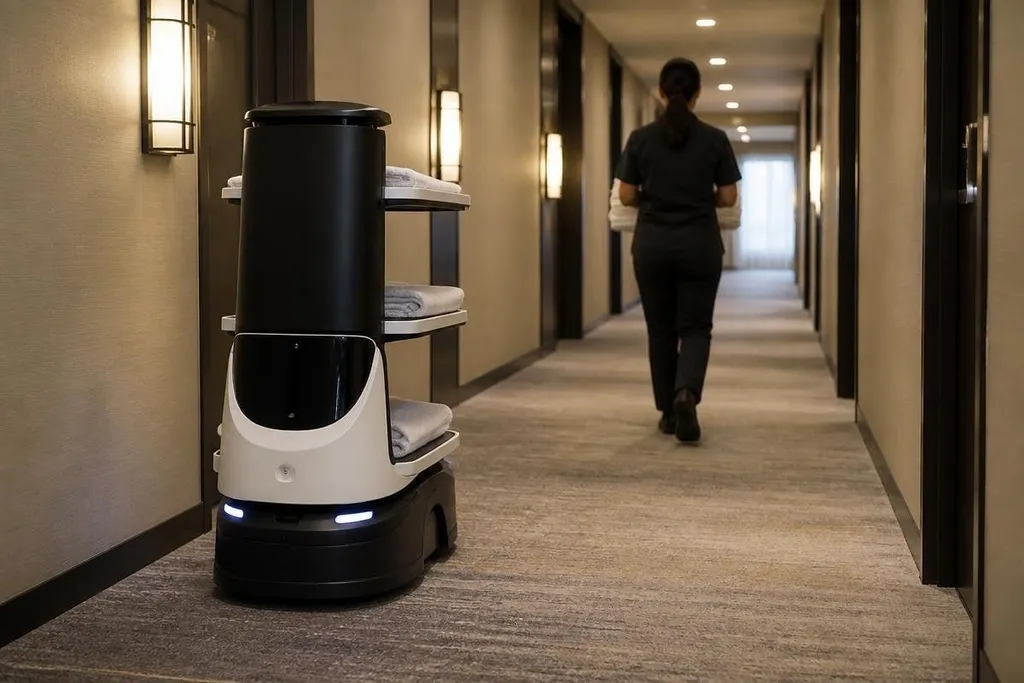
The task needs a clear start and finish. A delivery robot might collect a tray from a kitchen, travel to a guest floor, call the lift, and open a compartment for collection. A transport robot may carry clean linen between a storage room and a service area, but the building must support that route.
These jobs suit robots because the work has a fixed load, a known destination, and repeatable steps. Room service adds harder cases. Guests may enter the robot's path, a door may stay closed, or the order may need a human explanation.
The building decides the result
A hotel is a public space, not a test track. Carpet changes wheel motion. Glass walls can confuse sensors. Stairs stop many wheeled systems, and lifts may need a building connection or staff action.
The robot also needs a safe way to share space with guests. Its sensors must detect people, bags, carts, and furniture. Its speed needs to suit the corridor, not an open warehouse. A loud motor, a flashing light, or a blocked doorway can turn a short delivery into a service problem.
Access matters just as much. A robot that reaches the lobby but cannot open a fire door has an incomplete route. The same applies to kitchens, staff-only areas, and guest floors that need card access.
The risks staff will notice first
Safety comes before the task list. A hotel should know where the robot stops, how staff stop it, and who responds when it cannot continue. That response cannot depend on one person carrying a phone through a busy shift.
Privacy needs a clear rule too. Cameras and microphones may help a robot detect obstacles or speak with a guest. They also create questions about storage, access, and deletion. The operator should state what the robot records and why.
Guest service brings a separate risk. A robot can carry a meal, but it cannot read every social cue at the door. A guest with a complaint needs a person who can listen and fix the order. Automation can handle movement; it does not remove the need for service staff.
A product video shows one chosen moment. A hotel trial needs the task, site, and result around it. Reports on hospitality robots can add those facts when a hotel, maker, or research team shares records from a working site. Those records set up the next check: which numbers show a real change for staff or guests?
What the numbers need to prove
A buyer needs site measurements before approving a purchase. Public claims often leave out the costs around the robot: mapping, network access, lift integration, staff training, service calls, and floor changes.
The useful comparison is the complete task, not the robot's purchase price alone. Count the time staff spend walking, loading, waiting, answering alerts, and fixing failed deliveries. Then compare that total with the robot's lease or purchase cost, charging needs, maintenance, and supervision.
Price and runtime are still open points for many hospitality robots. They vary by model, contract, payload, software, and site work, so a general payback figure would mislead you without a named product and a real quote.
I'd approve a hospitality robot only after a short site trial measures missed deliveries, staff response time, blocked routes, and guest complaints.
A practical buying checklist
Use these checks before a hotel moves from a demo to a paid trial:
- Map the route: record every door, lift, threshold, stair, and staff-only zone.
- Set the load: define the tray, bag, linen cart, or other item the robot must carry.
- Name the responder: assign a person for alerts, stuck robots, and guest questions.
- Check privacy: write down camera use, audio use, storage time, and access rights.
- Measure the baseline: time the current task across a normal shift before comparing results.
A useful pilot should leave records that another manager can check: route failures, response time, service quality, and the full cost of running the system. Until a robot passes those tests in the target hotel, treat it as a tool for one narrow job, not a replacement for the hospitality team.